
Nicollet County Projected Versus Actual
A projected date is a forward-looking calculation. An actual release date records what happened. Nicollet County's current roster sometimes labels a future date as “Outdate” for a sentenced person who remains listed. The county does not publish the formula behind that field. Read it as an administrative estimate, not proof that the person left jail on that date. A court order, discipline, hold, transfer, or correction can change the outcome.
Pretrial status works differently. A person awaiting case resolution may leave after bond, recognizance, dismissal, or another court order, but there is no sentence endpoint to calculate. A scheduled hearing is not a release date. Huber work release also creates a misleading physical signal because someone can leave for approved activity while remaining legally confined.
After release, ask the Nicollet County Sheriff for the public date, time, and legal basis under Minn. Stat. § 13.82, subd. 2(i). For a transfer, paragraph (h) provides the date, time, legal basis, and recipient. Those fields distinguish release to the community from a move to another custodian.
Find Nicollet County Projected Dates
Begin by identifying the custody system. The Nicollet County in-custody roster can show an Outdate for some sentenced jail inmates. It does not contain a historical released tab. The MN DOC Locator covers people committed to the Commissioner who remain under DOC jurisdiction, either incarcerated or released from prison under supervision. A county booking alone does not create a DOC record.
- Check the Nicollet roster and record the booking number, status, hold, and any Outdate.
- Read the Nicollet District Court sentence and jail-credit entries when a county sentence is involved.
- Ask Jail Administration for the current county calculation; do not build a private calculator from incomplete inputs.
- If the sentence is to the Commissioner, search the DOC Locator by OID or exact name.
- Read the live DOC status, location or office, and each date label exactly as displayed.
- After the event, obtain the actual release or transfer record from the responsible agency.
The official Minnesota DOC search screen is the correct starting point for a Nicollet-connected state prisoner.
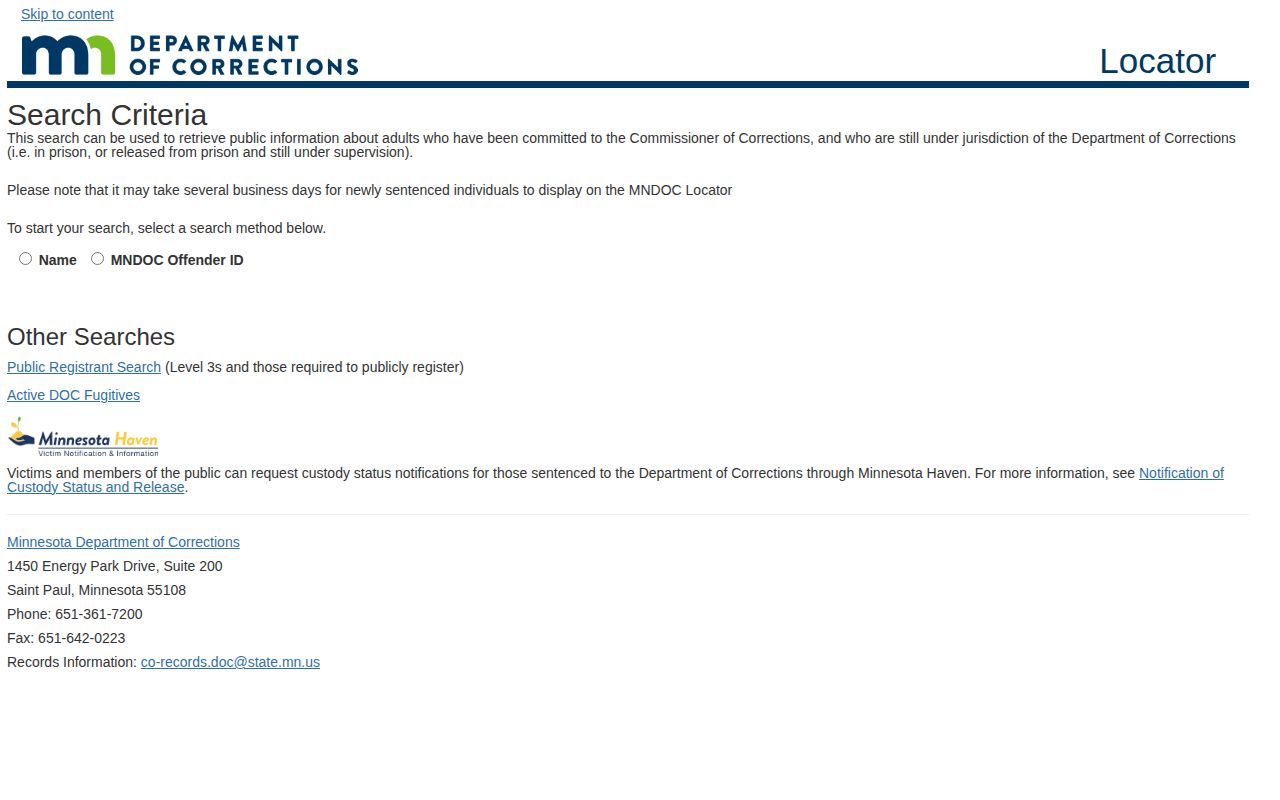
The Locator must be read within its jurisdiction limit: a fully discharged person may no longer be returned.
The full Nicollet County release verification path adds the sheriff record and court history when the projected field alone cannot answer the question.
Nicollet County Release Date Labels
Several Minnesota labels sound alike but carry different legal meaning. Normalizing them all to “release date” creates errors. The live source wording should be preserved with the date on which it was checked.
- Outdate
- A forward-looking Nicollet jail label shown for some sentenced people who are still in custody.
- Supervised release date
- The transition from state prison confinement to supervised release, while DOC jurisdiction continues.
- Sentence expiration
- The end of the executed sentence, generally later than ordinary supervised release.
- Parole Eligibility Date
- The earliest date an eligible Board case may be considered. Eligibility is not release.
- Projected release date
- A date the Supervised Release Board may assign in its limited case population.
- Actual release date
- The event date recorded after the custodian completes a release.
The Minnesota Supervised Release Board serves a narrow population, including eligible life-with-release, old indeterminate, and certain certified-adult cases. It is not a parole step for every ordinary determinate prisoner. An agenda entry is not a decision. Approved minutes provide the cleaner account of Board action.
Nicollet Board Release Date Records
Board records require a sequence of their own. The Parole Eligibility Date, or PED, is the earliest statutory point at which an eligible person may be released. It does not promise release or show that a hearing ended with approval. The Board says it begins an initial readiness review three years before minimum eligibility. At review, it may assign a projected release date or continue the matter with directives that must be addressed before another review.
The Board hearing schedule publishes upcoming meeting information, agendas, streams, and recent past materials. An agenda identifies what is set for review. A live stream records a proceeding as it occurs. Neither should be reported as the final result when approved minutes are available. The minutes can record a projection, continuance, grant or denial, violation action, or final discharge. Older decisions may require a Board or DOC records request because the schedule page keeps only a limited recent set.
This route applies only when the sentence falls within Board jurisdiction under Minn. Stat. § 244.049 and the related eligibility provisions. Ordinary determinate state prisoners normally move through the statutory confinement and supervised-release calculation. County jail Outdates remain outside the Board process. Checking the sentence type first prevents a Board schedule from being used for a Nicollet jail term or a routine DOC case it does not control.
Minnesota Rules Shape Nicollet Dates
Minnesota does not use a blanket rule that every prisoner serves 85 percent. For ordinary offenses committed on or after August 1, 1993, Minn. Stat. § 244.05, subd. 1b generally divides the fixed executed sentence into two-thirds imprisonment and one-third supervised release. Disciplinary confinement and statutory exceptions can delay the move to community supervision. Conditional-release terms for specified offenses can add a separate requirement.
The Minnesota Rehabilitation and Reinvestment Act adds earned incentive release credit. Under § 244.44, earned credit is included when imprisonment is calculated, cannot exceed 17 percent of the executed sentence, and cannot reduce imprisonment below one-half of that sentence. It does not shorten the total supervised-release term. The maximum is not automatic. It depends on eligibility and earned progress under an individualized plan.
Section 244.45 excludes life sentences, certain old indeterminate sentences, and people governed by old good-time or similar law. These distinctions are why a generic online calculator is unreliable. Current agency calculations and current statutory text control.
Note: Minnesota's 17-percent credit ceiling can resemble another percentage rule, but the state's own sentence structure and individual eligibility must lead.
Why Nicollet Release Dates Change
A projection describes the known facts at one point in time. Later legal or administrative events can alter the calculation. Keep the as-of date of every roster or DOC result and do not overwrite an older projection with an assumed actual date.
For a county term, the starting point is the executed jail sentence and the jail credit recognized in the case. Jail Administration may also need to account for another hold, an amended order, discipline, consecutive custody, or transfer. The public roster does not expose that calculation. Ask for the current Outdate explanation tied to the booking and compare it with the sentencing record. After departure, obtain the actual release or transfer fields instead of treating the last projection as if it occurred.
| Factor | Possible effect |
|---|---|
| Amended sentence or jail credit | Changes the term or credited time used in calculation |
| Disciplinary confinement | May delay state supervised release |
| Earned incentive credit | May reduce eligible prison confinement within statutory limits |
| Detainer or agency hold | Can cause transfer rather than community release |
| Consecutive sentence or revocation | Adds custody time or restores confinement |
| Board continuance | Leaves an eligible case pending with directives |
| Release-plan approval | Can affect readiness for a community transition |
| Data correction | Replaces an erroneous or incomplete projection |
Parole and probation are not interchangeable here. Ordinary supervised release follows a state prison term. Probation is a court-ordered community sentence or condition. The Board handles only its statutory cases. A local Community Corrections contact may route a Nicollet probation question, but private supervision notes should not be expected.
Weekend Nicollet Release Date Rules
Minnesota's weekend and holiday rule changes by offense date. Under § 244.05, subd. 1a, a qualifying supervised-release date for a crime committed before August 1, 1992 moves to the prior day that is not Friday, Saturday, Sunday, or a holiday. For a crime committed on or after that date, the date moves to the next day that is not Friday, Saturday, Sunday, or a holiday.
This rule concerns DOC supervised release under the statute. It should not be imposed on every Nicollet County Jail Outdate. County cases may depend on the local sentence, court order, jail credit, another hold, and jail administration. The source system and offense era matter. A reader should ask which authority calculated the date before applying the state-prison rule.
The Supervised Release Board also uses distinct timing. It says an initial readiness review occurs three years before minimum eligibility in covered cases. The Board may assign a projected date or continue the case with directives, but it cannot release someone before the statutory minimum eligibility date.
Confirm Nicollet County Actual Release
For Nicollet jail custody, confirm the completed event with Jail Administration or the Sheriff's records inquiry. Ask for the existing release or transfer fields tied to the booking. A court sentence explains authority and duration, yet it may not show the jail's exact release timestamp. The jail event proves the custody transaction, while the court record explains the disposition. Both can be necessary.
For state prison, read the DOC Locator and then contact DOC records for sentence computation or a historical discharged record. A community-supervision status means prison confinement ended, not that the sentence expired. In a Board case, consult the meeting schedule and approved minutes, not just the agenda or stream.
County-jail notification can be added through the Nicollet County VINELink check. State-prison notifications use Minnesota Haven instead. Automated notice remains a cross-check, not the final record. Preserve each date label, source, and access date, then verify actual release with the agency that performed it.
When the displayed date passes but the person still appears in custody, start with the holding agency rather than guessing at the cause. Ask whether the field was recalculated, whether a hold or court order intervened, and whether the displayed date has a new as-of value. If the person no longer appears, ask the sheriff for the release or transfer transaction. For DOC custody, request the current computation or historical release record using the OID and a defined date range. A clean sequence preserves the projection first, checks the agency's current calculation second, and records the completed event last. That approach also keeps a county Outdate separate from a DOC supervised-release date and a Board projection.
Note: A new hold can turn an expected community release into a transfer, so ask for both the legal basis and receiving agency.
Public Record Search
Sponsored Results